
Head of the Department
Programme
Master of Business Administration
Approved Intake
120 Students
Programme Structure
Two-Year Full-Time MBA


The Department of Management Studies develops future-ready business professionals through management education, experiential learning, leadership development, entrepreneurship, business analytics and industry-oriented learning.
Academic direction of the Department of Management Studies.
To shape responsible and visionary leaders equipped with global business acumen and deep-rooted ethical values, who will drive sustainable growth, innovation, and transformation in emerging economies and underserved regions.
Faculty of the Department of Management Studies.
















Administrative and supporting staff of the department.

Experiential and technology-enabled laboratory courses supporting business communication, data analysis, statistical analysis and managerial decision-making.
This experiential course develops the communication skills required for effective management and professional practice. Students engage in practical exercises covering oral and written communication, presentations, business reports, proposals, interviews, group discussions and professional networking. The course enables students to communicate clearly, confidently and persuasively in workplace situations.
Students will develop the ability to communicate clearly and effectively in professional and managerial contexts through oral and written communication, presentations, business reports, proposals, group discussions, interviews and professional networking.
This hands-on laboratory develops students' ability to use Microsoft Excel for business data analysis and decision-making. Students work with spreadsheets to organize, analyse and visualize data, perform statistical analysis, assess risk, and evaluate different business scenarios.
Students will develop practical proficiency in using Microsoft Excel to organize, analyse and visualize business data, perform statistical, risk, time-series, sensitivity and scenario analyses, and generate insights to support data-driven managerial decisions.
This practical course introduces students to statistical analysis and professional statistical software for business and research applications. Students learn to manage datasets, perform descriptive and inferential analysis, test relationships and develop statistical insights for managerial decision-making.
Students will develop the ability to apply statistical techniques using SPSS to analyse business and research problems, perform descriptive and inferential analyses, examine relationships through correlation and regression, and interpret statistical results for informed decision-making.
The Business Simulation laboratory provides students with an experiential environment to understand and practise managerial decision-making. Students explore simulation tools and modelling approaches and apply them to marketing, finance, operations and human resource management. The course also introduces ethical considerations, risk management and emerging technologies in business simulation.
Students will develop the ability to apply business simulation and modelling techniques to analyse and evaluate managerial decisions across marketing, finance, operations, human resources and supply chain management while considering risk, ethics, data privacy and emerging technologies.
Academic, industry and management experts involved in curriculum development.
Academic curriculum documents for the Master of Business Administration programme.
Programme-specific competencies expected from graduates of the MBA programme.
Managerial Decision Making: Apply management concepts, analytical methods and digital tools to analyse business problems and make effective data-driven managerial decisions.
Innovation, Entrepreneurship and Sustainable Business: Apply innovation, design thinking, entrepreneurial and sustainable management principles to develop viable solutions for organizational and societal needs.
Educational objectives describing the professional and societal accomplishments expected from MBA graduates.
Employability: To develop students with industry specific knowledge & skills to meet the industry requirements and also join Public sector undertaking through competitive examinations.
Entrepreneur: To create effective business service owners, with a growth mindset by enhancing their critical thinking, problem solving and decision-making skills.
Research and Development: To instil and grow a mindset that focusses efforts towards inculcating and encouraging the students in the domains of research and development.
Contribution to Business World: To produce ethical and innovative business professionals to enhance growth of the business world.
Contribution to the Society: To work and contribute towards holistic development of the society.
Knowledge, skills, professional competencies and values expected from graduates of the MBA programme.
Problem Solving Skill: Application of tools & techniques relevant to management theories and practices in analyzing & solving business issues.
Decision Making Skill: Application of analytical and critical thinking models for data-driven decision making.
Ethical Value: Nurture the development of ethical practices in business and work.
Communication Skill: Be trained in and to practice skills of listening, verbal and non-verbal communications for effective information and knowledge transfer.
Individual and Team Leadership Skill: Ability to be self-motivated in leading & driving a team towards achievement of organizational goals and contributing effectively to establish industrial harmony.
Employability Skill: Foster and enhance employability skills through relevant industry subject knowledge.
Entrepreneurial Skill: Equipped with skills and competencies to become a successful entrepreneur.
Contribution to Society: Strive towards building and delivering products and services with a social benefit perspective.
Semester schedules and academic activities of the MBA programme.
Department activities, achievements and management events.
Information about the Department of Management Studies and MBA programme.
Connecting management education with business practice.
Industrial visits and interaction with organisations help MBA students understand how management principles are applied in real business environments. Such exposure supports practical understanding of operations, human resources, finance, marketing, logistics and organisational management.
The programme encourages entrepreneurial thinking, business-model development, opportunity identification, leadership, innovation and problem solving so that students can explore both corporate careers and entrepreneurial pathways.
Business communication, presentations, group activities, management exercises and career-readiness activities develop professional confidence, interpersonal effectiveness and workplace competence.
Students can also benefit from the college's broader industry and institutional collaborations through technical interactions, training activities, professional exposure and interdisciplinary events.
Preparing MBA students for corporate, managerial and entrepreneurial careers.
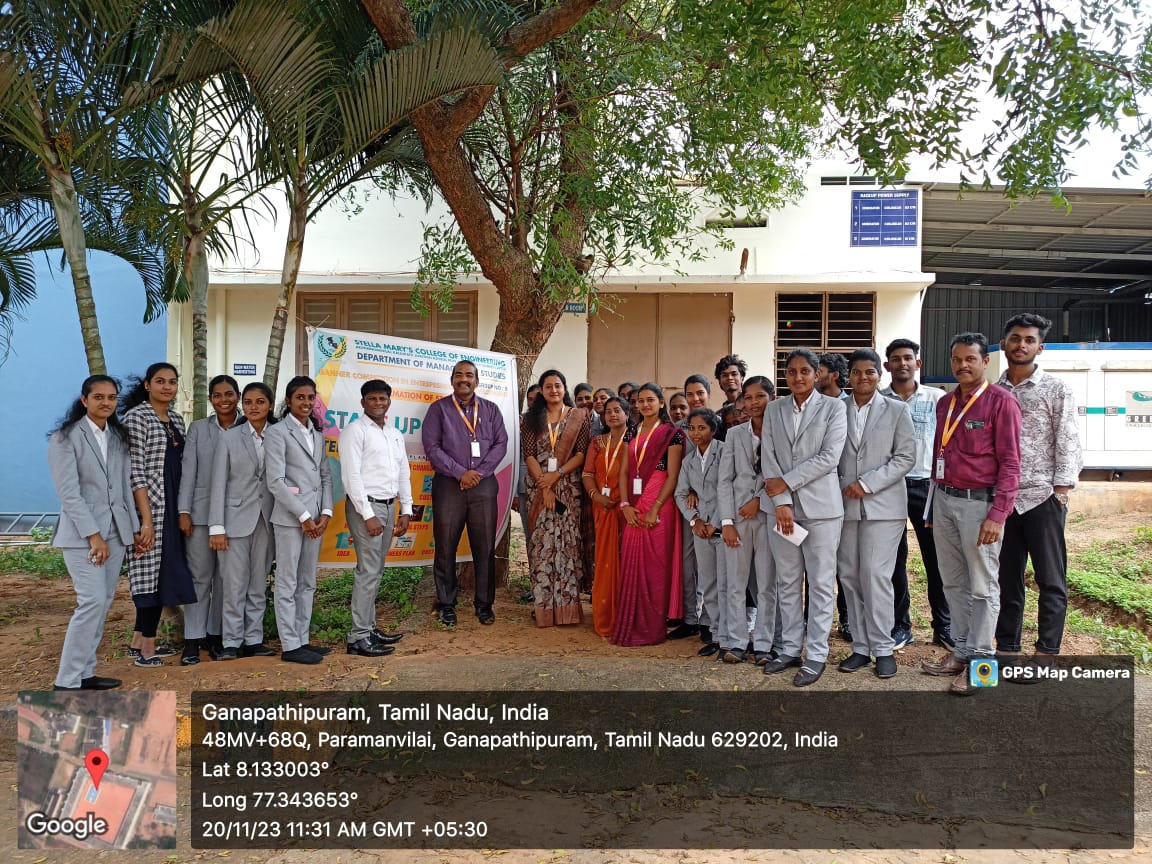
Activities and learning experiences of the Department of Management Studies.
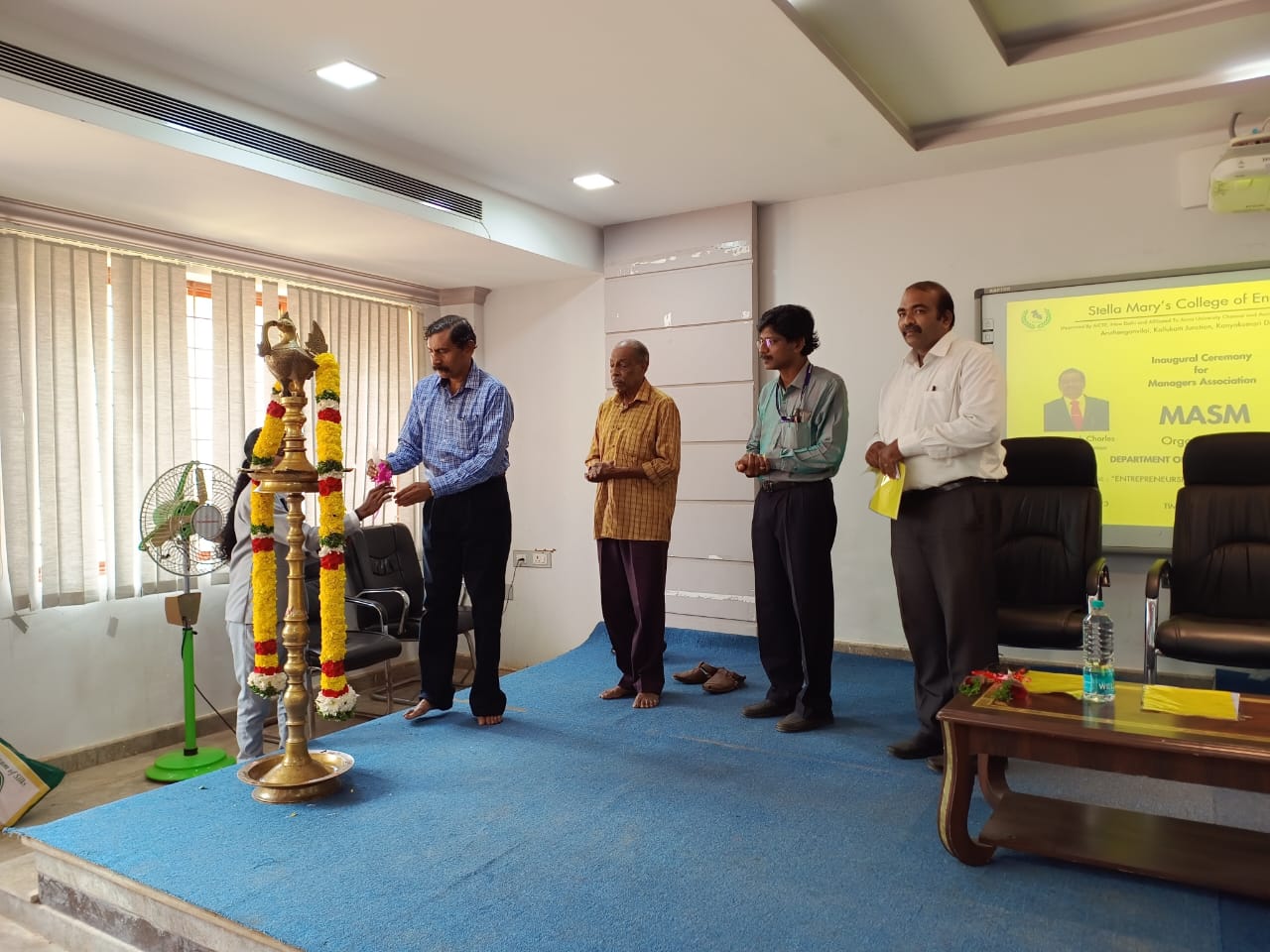
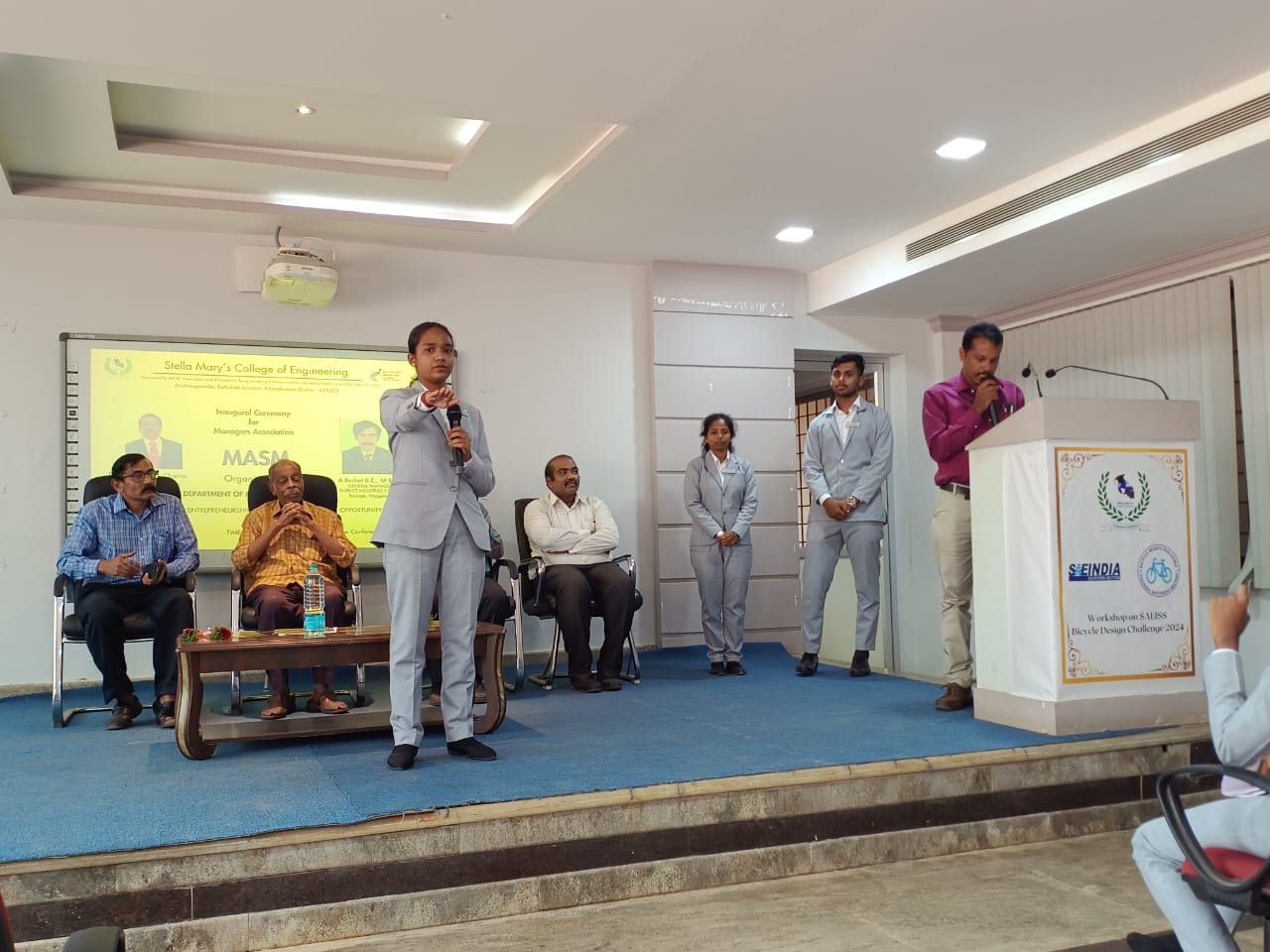
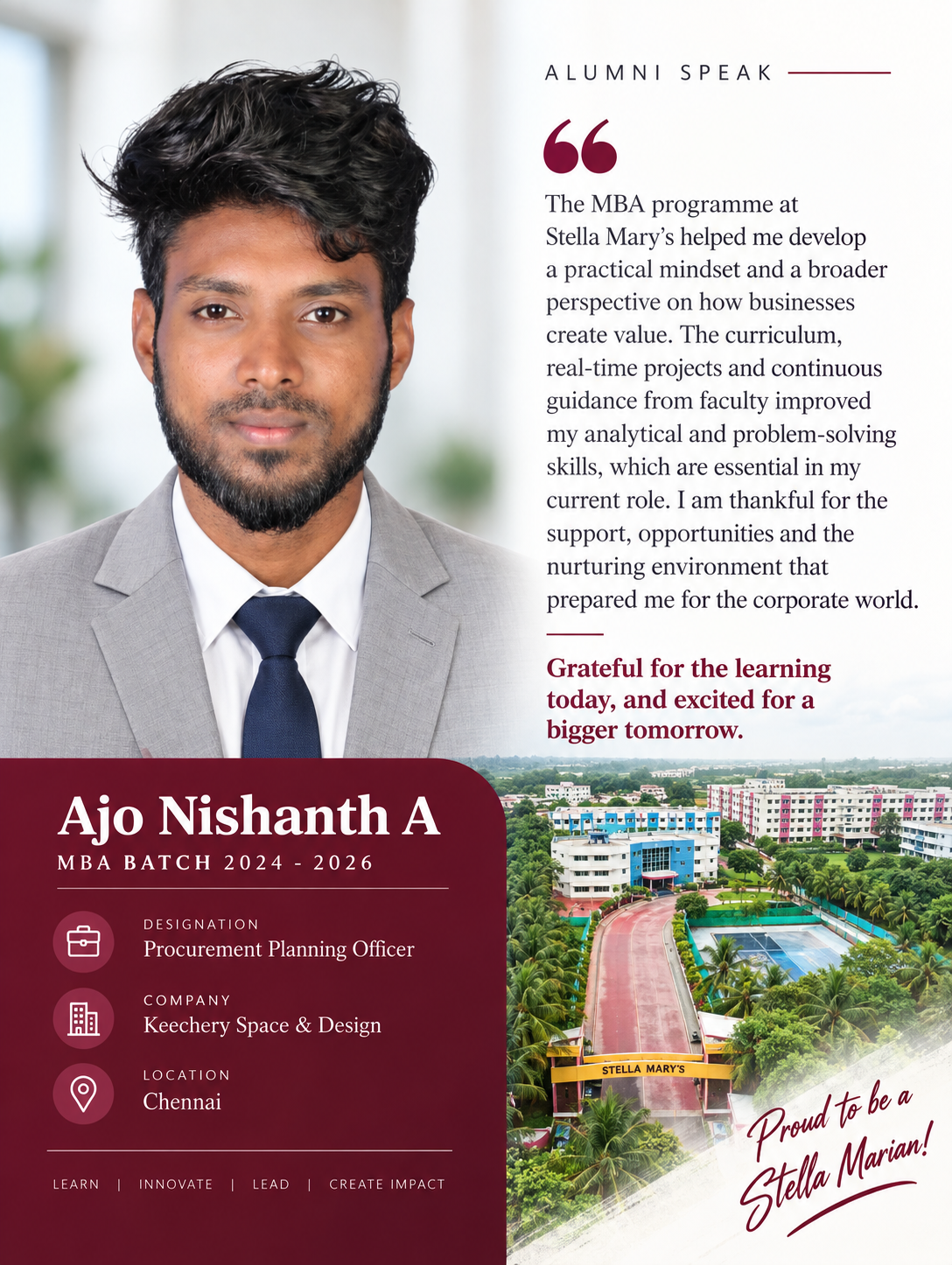
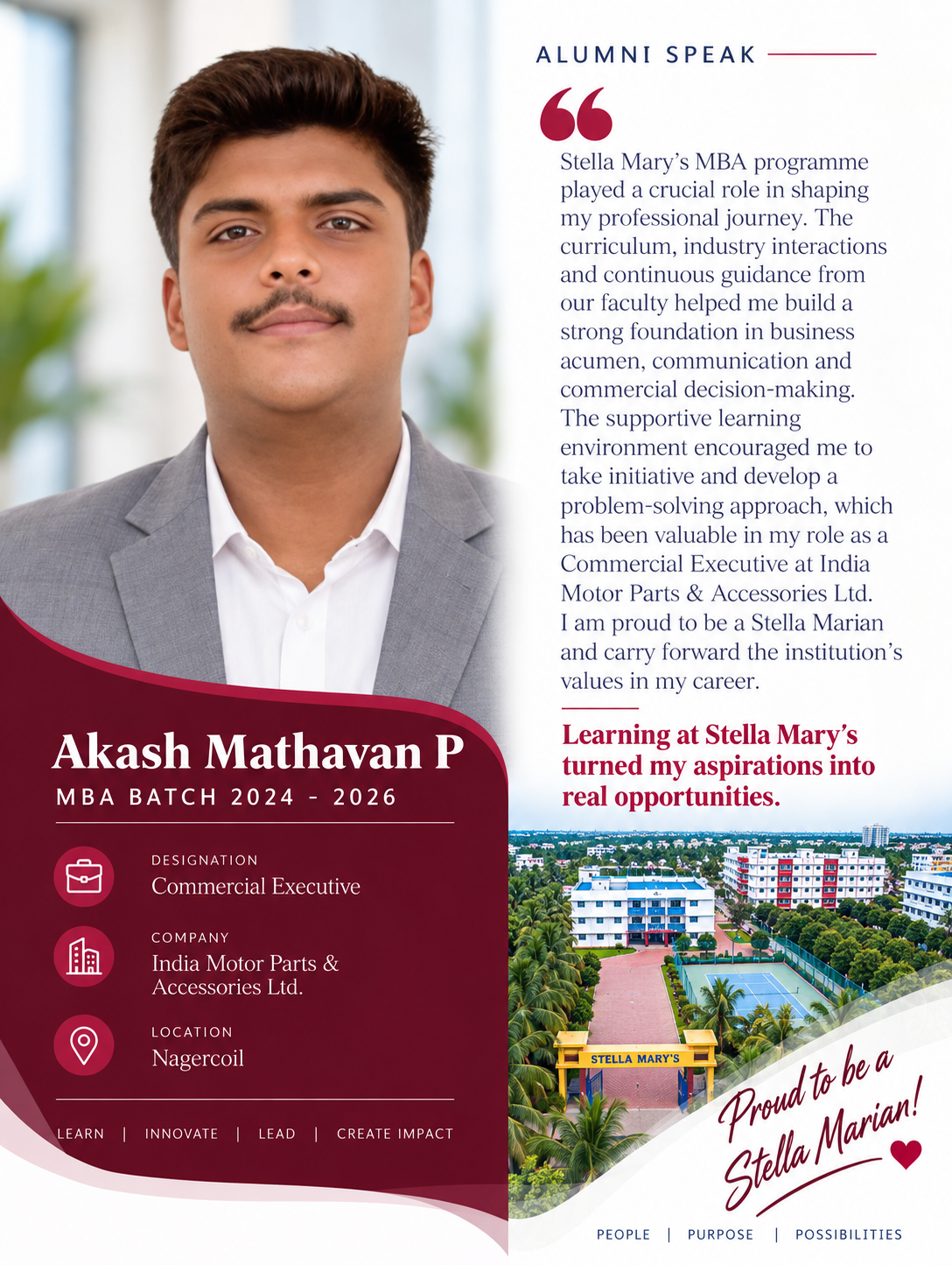
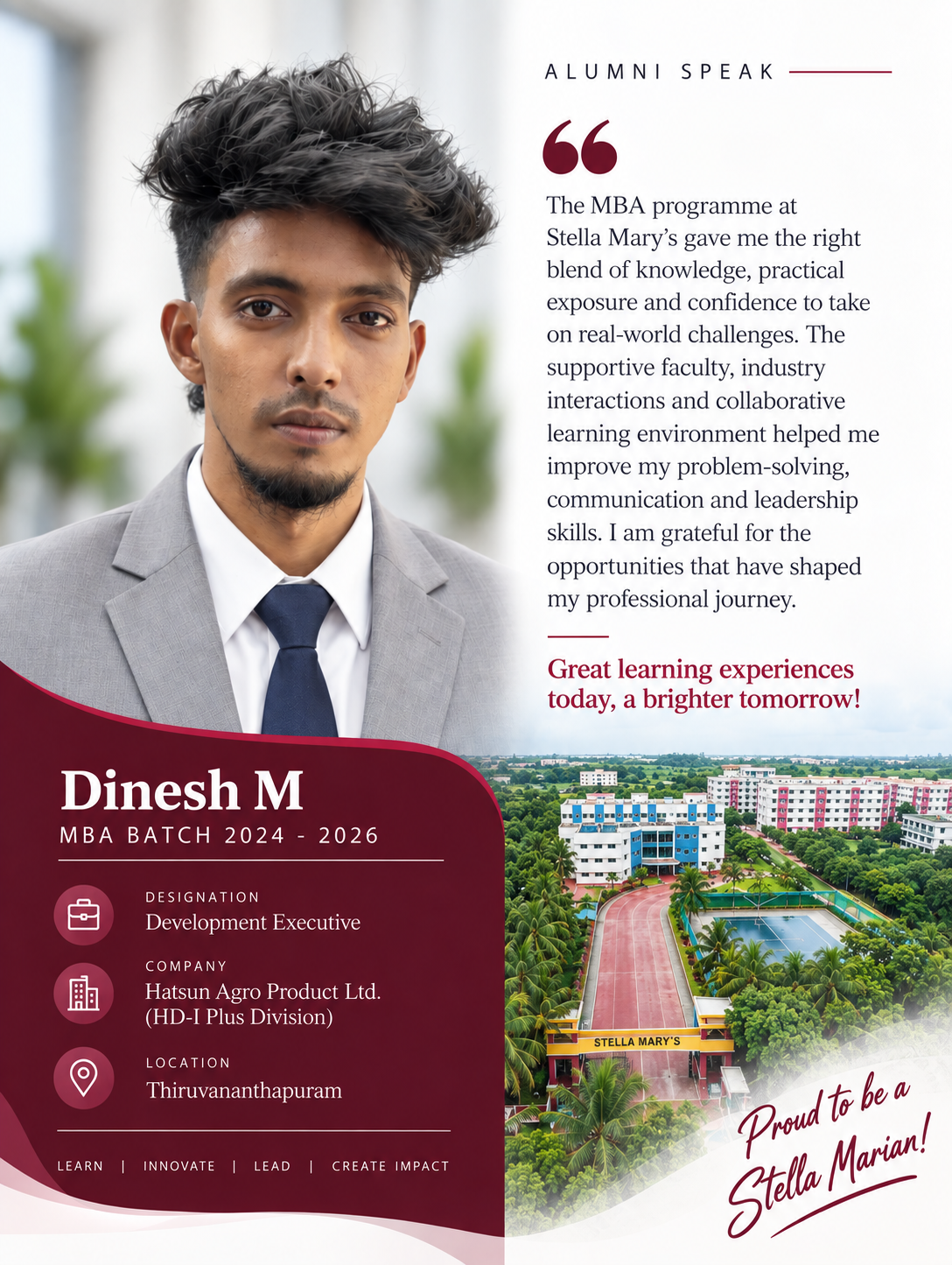
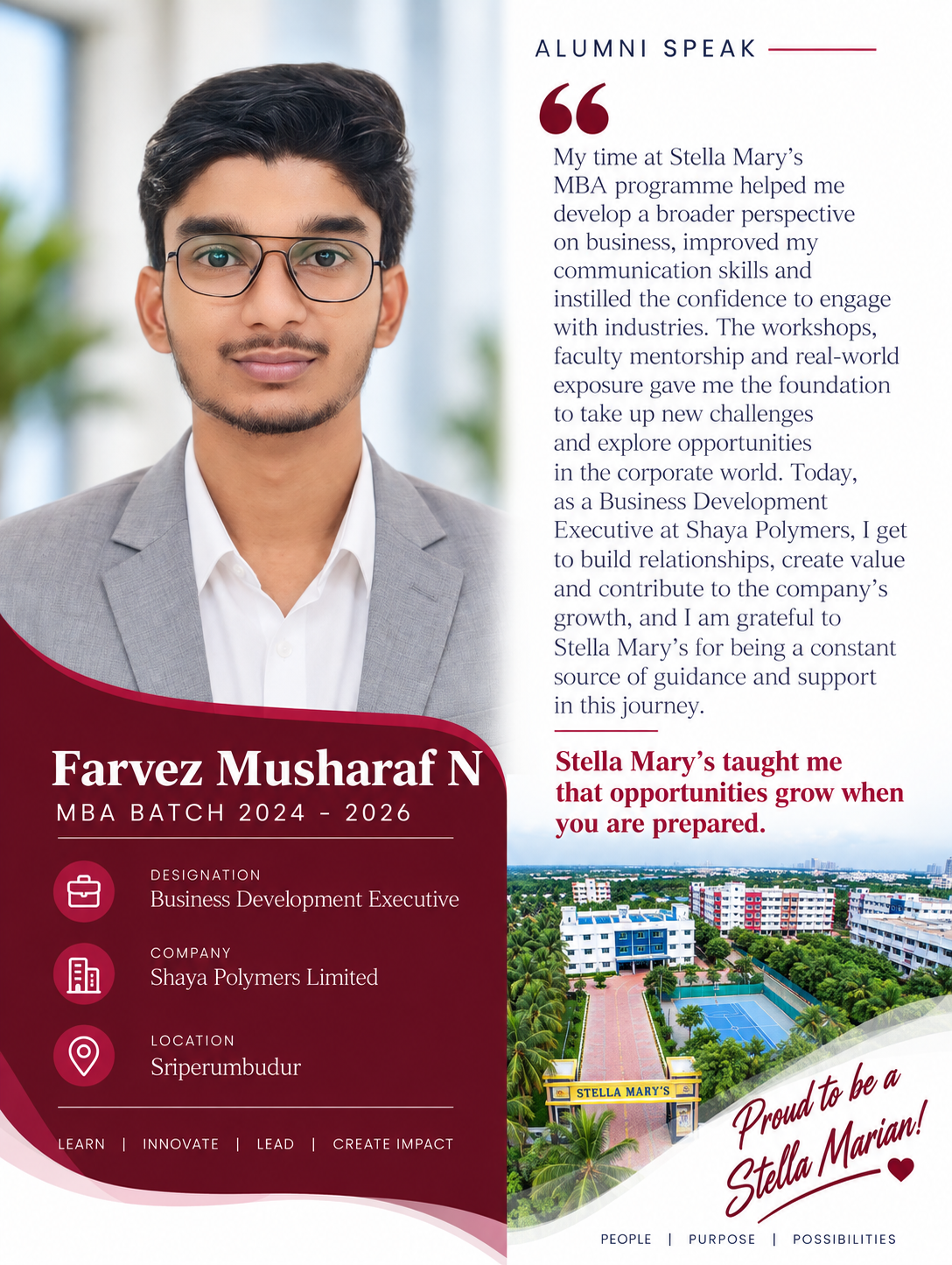
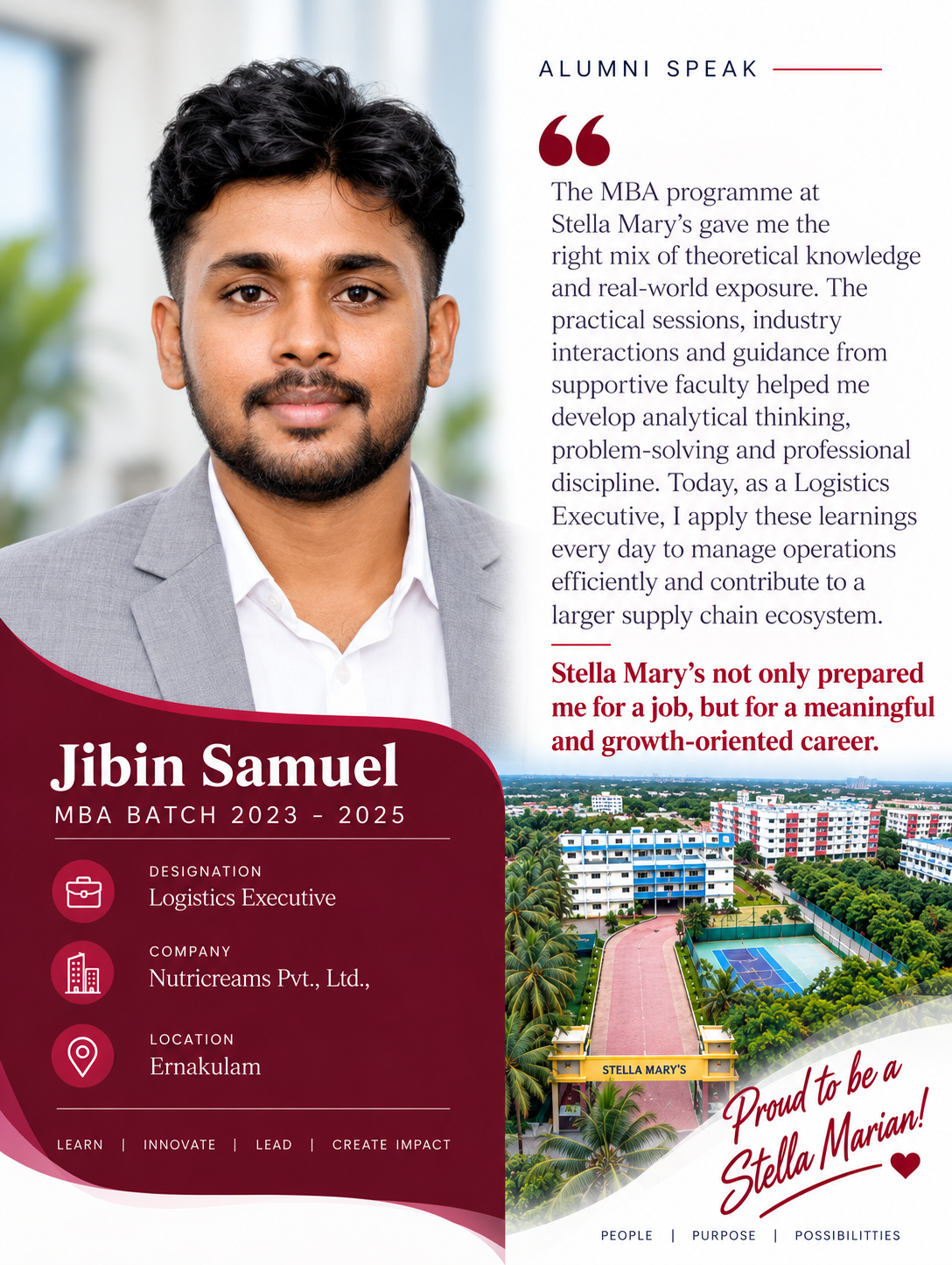
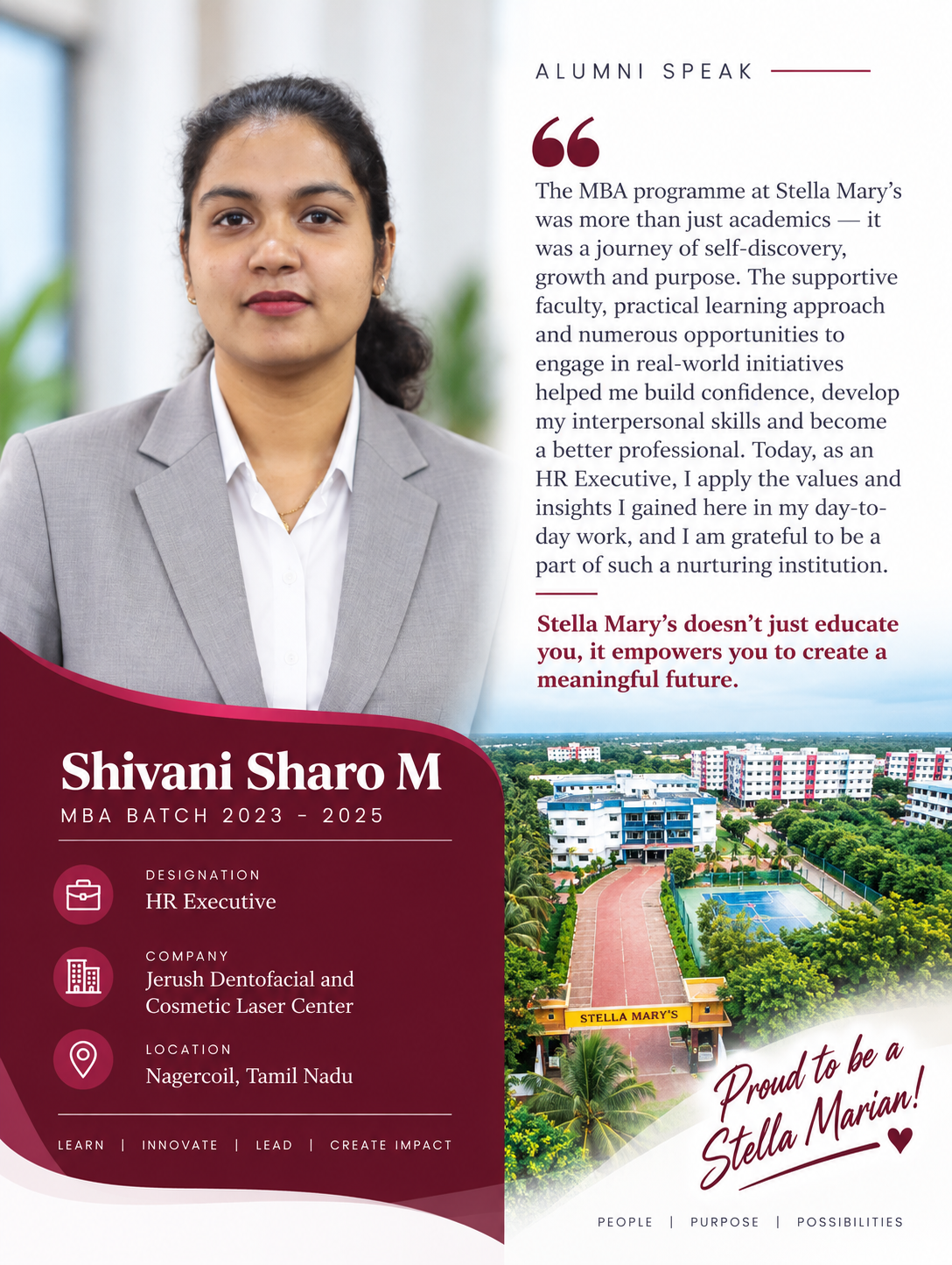
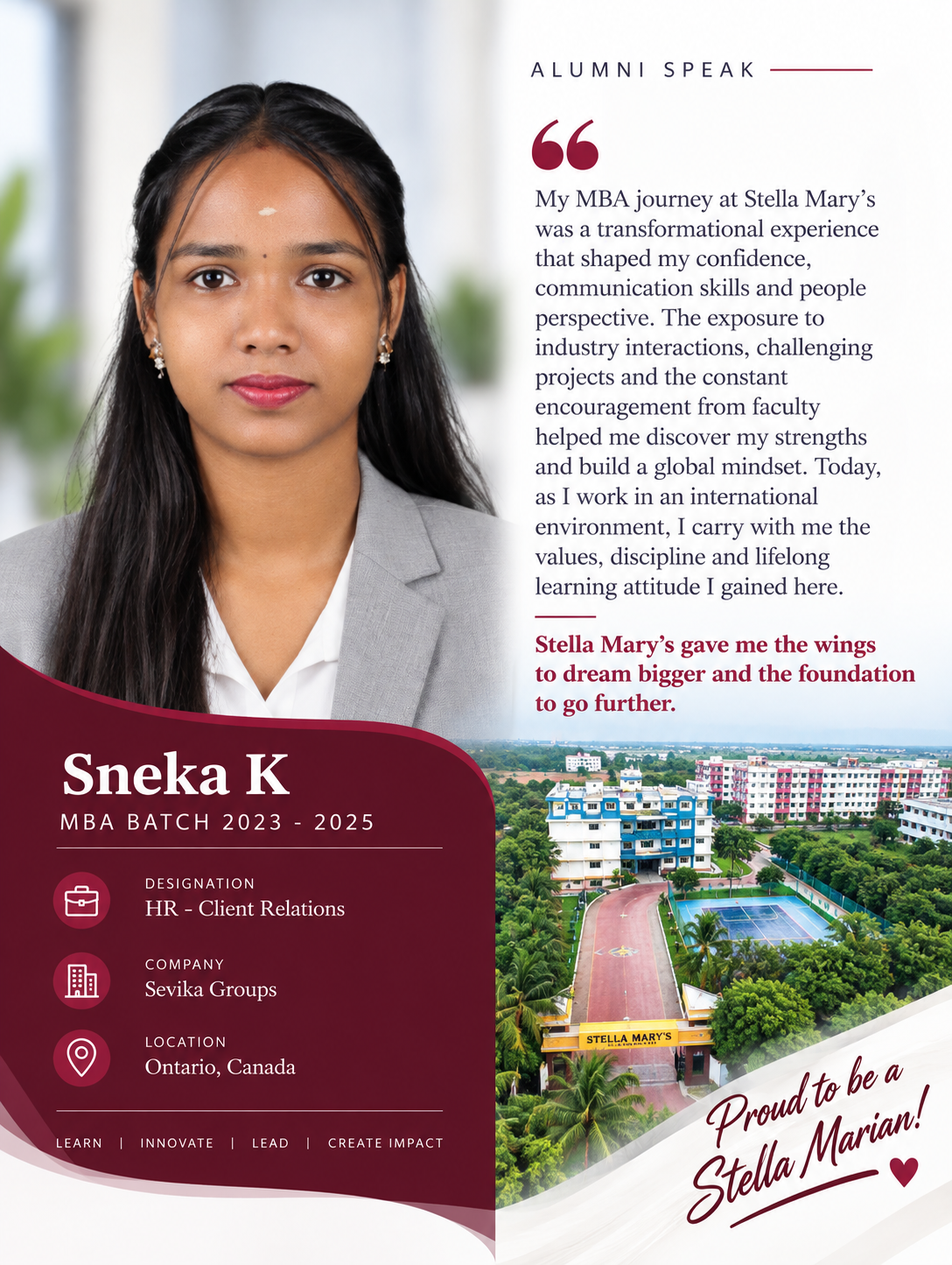
Experiences and reflections shared by students of the Department of Management Studies.





Quick information about the Master of Business Administration programme and Department of Management Studies.
Yes. Stella Mary's College of Engineering offers the Master of Business Administration (MBA) postgraduate programme through its Department of Management Studies.
The MBA programme has an intake of 120 students.
The MBA is a two-year full-time postgraduate programme comprising four semesters.
The Department of Management Studies is headed by Dr. M. Dhiliphan Kumar.
The programme supports areas such as Marketing Management, Human Resource Management, Financial Management, Operations Management, Logistics and Supply Chain Management, along with other management electives subject to the applicable curriculum and academic provisions.
MBA students are supported by the Business Communication Laboratory and the Data Analysis and Business Modelling Laboratory.
The Data Analysis and Business Modelling Laboratory supports learning using tools and methods associated with SPSS, Microsoft Excel, POM and TORA for statistical analysis, finance, operations research, forecasting and business modelling.
Yes. Regulation 2021 and Regulation 2024 MBA curriculum and syllabus documents are available from the Syllabus section of this page.
MBA graduates can pursue careers in marketing, human resources, finance, banking, operations, logistics, supply chain management, business development, analytics, consulting, project management and entrepreneurship.
Yes. The programme combines classroom learning with business communication activities, data analysis, business modelling, presentations, simulations, industrial exposure and other experiential learning activities.
Stella Mary's College of Engineering is located in Kanyakumari district, Tamil Nadu, India.